2026 Honda CR-V TrailSport Hybrid vs 2026 Toyota RAV4 Woodland
Honda Comfort, Toyota Utility & the Right Outdoor-Hybrid Fit
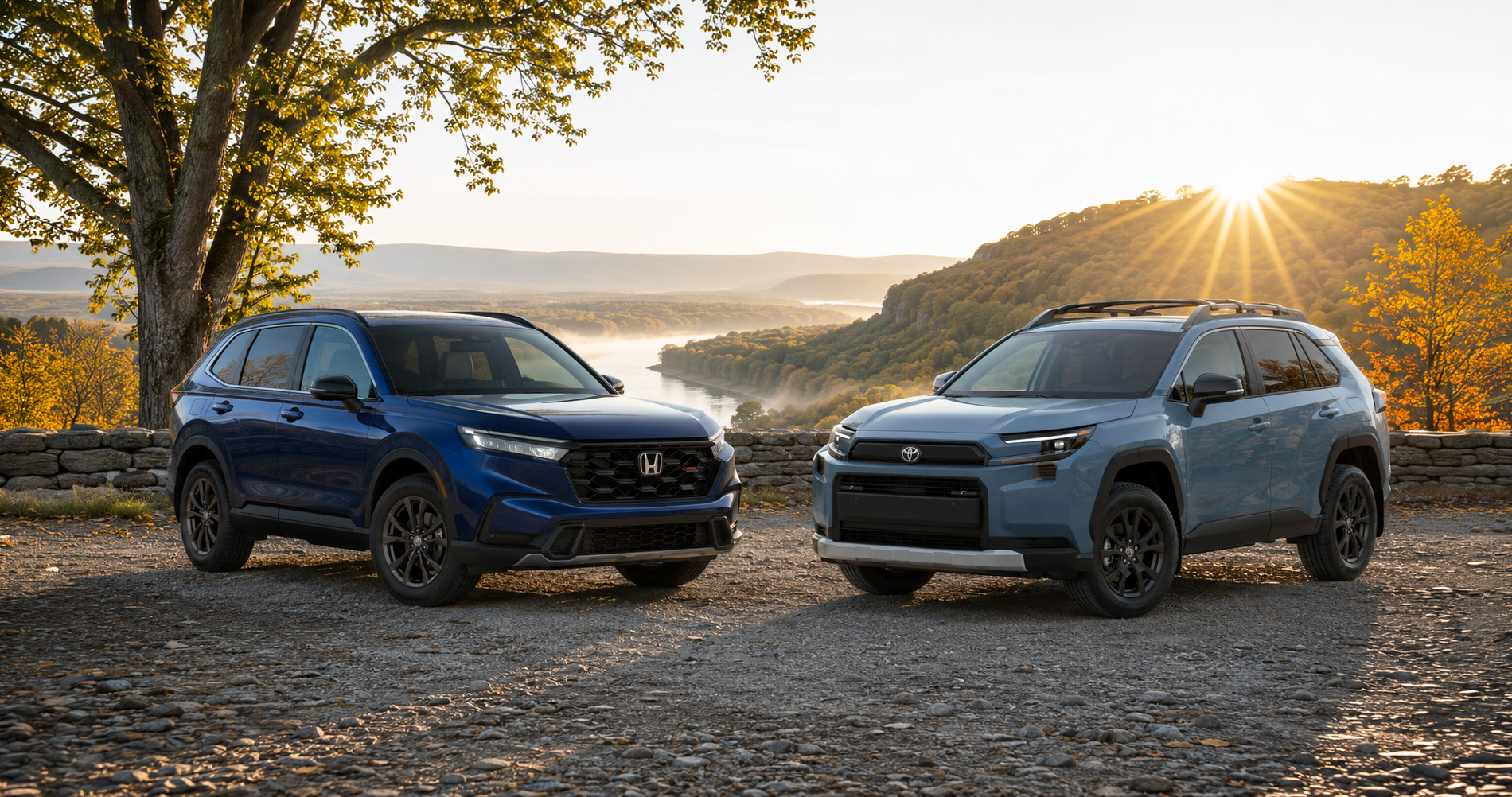
The 2026 Honda CR-V TrailSport Hybrid and 2026 Toyota RAV4 Woodland put all-wheel drive, hybrid power, all-terrain tires, and outdoor-inspired design into compact SUVs that still have to handle an ordinary week. The CR-V TrailSport Hybrid builds its case around passenger comfort, rear-seat usefulness, straightforward technology, heated convenience features, and Honda’s polished two-motor hybrid operation. The RAV4 Woodland places more emphasis on clearance, towing, factory roof and hitch equipment, cargo-area power, and a more visibly utility-focused package.
This comparison examines how those different priorities affect real ownership. It covers hybrid power and MPG, AWD operation, drive modes, all-terrain tires, ground clearance, towing, passenger and cargo space, outdoor equipment, technology, safety features, winter confidence, daily commuting, and weekend gear. It also separates useful light-trail capability from the dedicated off-road hardware neither SUV is designed to provide.
Neither is a dedicated rock-crawling SUV, and neither wins every category. Woodland is the stronger fit when a 3,500-lb towing rating, 8.5 inches of clearance, raised crossbars, a factory hitch, and trail lighting will be used. TrailSport Hybrid is the stronger place to start when Route 211 errands, I-84 or NY-17 commuting, winter travel, family seating, and daily cabin comfort matter more than maximum utility hardware.
Quick AnswersThe essential RAV4 Woodland vs CR-V TrailSport differences▼
What is the main CR-V TrailSport Hybrid vs RAV4 Woodland difference?
TrailSport Hybrid is the more comfort- and passenger-focused interpretation of an outdoor-themed hybrid SUV. Woodland provides more clearance, substantially greater towing capacity, and more factory utility equipment for trailers, roof gear, and rougher access roads.
Which model gets better MPG?
RAV4 Woodland has the higher listed estimate at 41 city, 35 highway, and 38 combined MPG. CR-V TrailSport Hybrid is EPA-rated at 38 city, 33 highway, and 35 combined MPG.
Which is better for towing and outdoor equipment?
RAV4 Woodland has the stronger utility package. It is rated to tow up to 3,500 lbs and includes a tow hitch, raised roof rails with crossbars, all-terrain tires, integrated Rigid Industries LED fog lights, and a 120V/1500W cargo-area outlet.
Which has the more useful passenger cabin?
CR-V TrailSport Hybrid lists more passenger volume and considerably more rear legroom. Woodland counters with slightly more cargo space behind the second row, so the useful difference depends on whether people or packed gear gets priority.
Which one should I test-drive first?
Start with the CR-V TrailSport Hybrid at Middletown Honda when seat comfort, rear-seat access, ride quality, visibility, controls, and hybrid smoothness could decide the comparison. Those qualities are harder to judge from a specifications chart.
Core Differences: 2026 CR-V TrailSport Hybrid vs 2026 RAV4 Woodland
Start with the ownership split before comparing every number. Both SUVs seat five, make AWD standard, use hybrid power, and wear all-terrain tires. TrailSport Hybrid uses those ingredients to support comfortable daily driving with added weather and unpaved-road confidence, while Woodland adds more factory equipment for towing, roof gear, clearance, and outdoor utility.
2026 Honda CR-V TrailSport Hybrid vs 2026 Toyota RAV4 Woodland at a GlanceShopper-level differences only. Detailed figures and equipment notes appear in the comparison slider below.
Category
2026 Honda CR-V TrailSport Hybrid
2026 Toyota RAV4 Woodland
Core Identity
A comfort-first hybrid compact SUV with standard Real Time AWD, all-terrain tires, TrailSport styling, and useful cold-weather equipment.
A utility-first hybrid compact SUV with standard Electronic On-Demand AWD, added clearance, a factory hitch, roof crossbars, and trail-oriented exterior equipment.
Best Fit
Daily commuting, frequent rear-seat use, family routines, mixed weather, and light unpaved-road access.
Drivers who will use stronger towing, higher clearance, factory roof equipment, cargo-area power, or rougher access-road capability.
Hybrid Power
204 total system horsepower from Honda’s two-motor hybrid system.
236 combined horsepower from Toyota’s AWD hybrid system.
AWD Approach
Real Time AWD uses a propeller shaft to send power to the rear wheels when additional traction is needed.
Electronic On-Demand AWD uses a dedicated rear electric motor rather than a mechanical connection to the front axle.
18-inch matte metallic gray wheels, P235/65R18 all-terrain tires, raised rails with crossbars, tow hitch, Rigid Industries fog lights, and Woodland mats and cargo liner.
8.5 inches plus more favorable listed approach and departure angles.
Fuel-Economy Direction
Strong hybrid efficiency, with the lower listed combined estimate of the two.
The higher listed city, highway, and combined estimates.
Passenger & Cargo Use
More passenger volume, more rear legroom, and slightly more maximum cargo volume with the rear seats folded.
Slightly more cargo room behind the second row and a shorter overall length.
Towing
Up to 1,000 lbs when properly equipped with the required Honda towing accessories.
Up to 3,500 lbs, with a factory tow hitch and a listed maximum tongue weight of 350 lbs.
What These Differences Mean
Woodland’s advantage is clearest when the outdoor equipment will be used rather than simply appreciated. Its towing capacity, approach geometry, roof setup, and cargo-area power make it easier to support trailers, bulky equipment, and trips that regularly include rougher access roads.
TrailSport Hybrid concentrates more of its appeal inside the vehicle. The additional rear-seat space, comfortable driving position, heated equipment, and straightforward controls have value during every commute, family trip, and winter errand. That makes the Honda’s case less about maximum capability and more about how naturally the outdoor equipment fits into normal ownership.
Third-Party Review Lens
What Reviewers Notice Beyond the Specifications
Towing, MPG, cargo volume, and clearance are easy to compare on paper. Ride quality, cabin refinement, seating comfort, and the way a hybrid powertrain behaves in traffic are harder to measure. Independent reviews help provide that broader context before the trim-specific data comparison begins.
Car and Driver emphasizes the CR-V Hybrid’s refinement, efficiency, passenger space, practical interior, and comfortable road behavior.
Why it matters: Those broader CR-V Hybrid strengths remain relevant to TrailSport Hybrid shoppers who want outdoor-inspired equipment without giving up the quiet, easy-to-use character that matters during commuting and family travel.
Reviewer Notes
2026 Toyota RAV4
8.5/10 C/D RatingNo. 5 Compact SUV*
Car and Driver presents the redesigned RAV4 as an efficient, practical hybrid compact SUV with useful space, a long feature list, and a more powerful AWD hybrid system.
Why it matters: Woodland adds a trim-specific utility layer that the general rating cannot capture by itself, including greater clearance, a higher towing rating, a factory hitch, crossbars, all-terrain tires, and cargo-area power.
The balanced takeaway
The CR-V Hybrid has the stronger current reviewer-accolade story, but that does not prove TrailSport Hybrid wins every trim-specific category. Woodland’s towing, clearance, and factory utility advantages are real. The right choice still depends on whether passenger comfort and daily refinement or outdoor equipment and trailer capability will matter more in ownership.
Compare CR-V TrailSport Hybrid & RAV4 Woodland by What Matters Most
Choose a topic to compare hybrid power, MPG, AWD operation, ground clearance, tires, passenger room, cargo, towing, technology, safety features, standard equipment, and buyer fit.
Select a Topic or Swipe to See More
Comparison Topic 1 of 7
Specs, Hybrid Power & MPG
Two efficient AWD hybrids with different output, pricing, and fuel-economy results
Powertrain, Pricing & MPG SnapshotMSRP and destination figures were current when reviewed. Honda figures are EPA estimates; Toyota Woodland figures are manufacturer estimates. Actual mileage will vary.
Category
2026 Honda CR-V TrailSport Hybrid
2026 Toyota RAV4 Woodland
Base MSRP*
$38,800
$39,900
Hybrid System
2.0-liter Atkinson-cycle four-cylinder with Honda’s two-motor hybrid system.
2.5-liter Dynamic Force four-cylinder with Toyota hybrid motors and an eCVT.
Combined Output
204 Combined HP 247 lb-ft. Torque
236 Combined HP Toyota does not publish hybrid-system torque.
Transmission / Power Delivery
Electric-continuously variable transmission behavior through Honda’s two-motor system, with B-range and deceleration selectors.
Electronically controlled continuously variable transmission with sequential shift mode.
MPG*
38 city / 33 highway / 35 combined
41 city / 35 highway / 38 combined
Fuel Capacity
14.0 gallons
14.5 gallons
Decision Meaning
Lower starting MSRP, strong urban efficiency, and smooth electric-motor response support comfort-first daily use.
More system horsepower and higher listed MPG support high-mileage driving without giving up Woodland equipment.
Powertrain Takeaway
Woodland combines more listed output with a three-MPG combined advantage, so it deserves the efficiency and power edge on paper. TrailSport Hybrid starts lower and uses Honda’s responsive two-motor system in a package focused more on refinement and passenger comfort than maximum output.
Comparison Topic 2 of 7
AWD, Drive Modes & Daily Performance
Mechanically connected Honda AWD versus Toyota rear-motor AWD
AWD & Driving-System ComparisonAWD and drive modes can support traction but cannot overcome inappropriate tires, unsafe speeds, or poor judgment. System behavior varies with conditions.
Category
2026 Honda CR-V TrailSport Hybrid
2026 Toyota RAV4 Woodland
AWD System
Real Time AWD with Intelligent Control System
Uses a propeller shaft and rear differential to transfer power rearward when needed.
Electronic On-Demand All-Wheel Drive
Uses an independent rear electric motor with 89 lb-ft of listed rear-motor torque.
Drive Modes
ECON, Normal, Snow, and Sport.
Trail, Snow, Normal, and EV modes on the Woodland center console.
Low-Speed / Descent Support
Hill start assist and hill descent control.
Hill Start Assist Control, Downhill Assist Control, and Trail mode.
Turning Circle
37.0 ft curb to curb.
37.0 ft curb to curb.
Winter & Wet-Weather Meaning
Standard AWD, Snow mode, heated steering wheel, heated front seats, and all-terrain tires support cold-weather daily driving.
Standard AWD, Snow and Trail modes, rain-sensing wipers with de-icer, all-terrain tires, and added clearance support changing weather and uneven roads.
Daily-Driving Direction
More emphasis on smooth hybrid response, settled passenger comfort, and easy commuting.
More emphasis on power, outdoor controls, and the traction tools packaged around Woodland use.
AWD & Performance Takeaway
The systems reach the same goal in different ways. Honda uses a mechanical rear connection and pairs it with a comfort-led chassis. Toyota powers the rear axle electrically and adds Trail mode, Downhill Assist Control, and a stronger outdoor-equipment package. Neither approach turns the SUV into a technical off-roader.
Comparison Topic 3 of 7
Ground Clearance, Tires & Outdoor Equipment
The most direct look at what each outdoor-themed trim actually adds
Clearance, Tires & Trail-Access EquipmentGround clearance and approach/departure figures are static measurements. Tires, loading, surface conditions, driver skill, and obstacles still determine usable capability.
Category
2026 Honda CR-V TrailSport Hybrid
2026 Toyota RAV4 Woodland
Ground Clearance
8.2 in.
8.5 in.
Approach / Departure Angles
16.1 / 21.3 degrees
20 / 24 degrees
Wheels
18-inch Shark Gray alloy wheels.
18-inch six-spoke matte metallic gray alloy wheels with black lug nuts.
Tires
P235/60R18 all-terrain tires.
P235/65R18 all-terrain tires.
Roof Equipment
Black roof rails; crossbars are not listed as standard TrailSport equipment.
Woodland-branded raised black roof rails with crossbars.
Tow hitch, Rigid Industries LED fog lights, black exterior accents, Woodland badging, overfenders, all-weather mats, and cargo liner.
Practical Meaning
Enough clearance and tire sidewall for snow, gravel, rutted driveways, campgrounds, and maintained trailhead roads.
More clearance, stronger angles, roof gear, lighting, and a hitch create the more complete factory utility package.
Outdoor-Equipment Takeaway
Woodland has the more substantial factory adventure package, especially when roof gear, a hitch, approach angle, or auxiliary lighting matters. TrailSport Hybrid is better understood as a daily-friendly CR-V Hybrid with useful all-terrain tires, AWD, added clearance, and weather-ready equipment.
Comparison Topic 4 of 7
Passenger Space, Cargo & Daily Use
More room for people in the Honda, slightly more rear-seat-up cargo in the Toyota
Passenger, Cargo & Exterior-Size ComparisonManufacturer measurement methods can differ. Seat position, moonroof installation, cargo-floor position, and loading method can affect usable space.
Category
2026 Honda CR-V TrailSport Hybrid
2026 Toyota RAV4 Woodland
Seating Capacity
Five
Five
EPA Passenger Volume
103.5 cu ft
98.9 cu ft
Front / Rear Legroom
41.3 / 41.0 in.
41.0 / 37.8 in.
Front / Rear Headroom
38.2 / 38.2 in.
37.9 / 39.5 in. with moonroof
Front / Rear Shoulder Room
57.9 / 55.9 in.
57.0 / 56.4 in.
Cargo Behind Second Row
36.3 cu ft
37.8 cu ft
Maximum Cargo Volume
71.8 cu ft
70.4 cu ft
Overall Length / Width
184.8 / 73.5 in.
182.0 / 74.0 in.
Daily-Use Meaning
More rear legroom and passenger volume support adults, child seats, and long trips with people in both rows.
A shorter body and slightly larger cargo area behind the rear seat support parking and gear loading.
Space & Daily-Use Takeaway
The passenger-space split is meaningful: the CR-V provides 3.2 inches more listed rear legroom and 4.6 cubic feet more passenger volume. Woodland counters with 1.5 cubic feet more cargo behind the second row and a body that is 2.8 inches shorter. Choose by whether the second row or the cargo area stays busier.
Comparison Topic 5 of 7
Towing & Weekend Utility
A clear towing difference supported by different factory equipment
Trailer, Roof-Gear & Cargo-Utility ComparisonMaximum towing requires proper equipment, loading, tongue weight, trailer brakes where required, and owner’s manual compliance. Passengers and cargo affect available capacity.
Category
2026 Honda CR-V TrailSport Hybrid
2026 Toyota RAV4 Woodland
Maximum Towing Capacity*
1,000 lbs
3,500 lbs
Factory Hitch
Available Accessory
Tow hitch standard.
Trailer Stability Support
Vehicle Stability Assist with traction control; follow Honda towing guidance.
Trailer-Sway Control standard.
Roof-Carrying Setup
Roof rails standard; accessory crossbars can be added.
Raised roof rails with crossbars standard.
Cargo-Area Power
12-volt outlet in the cargo area.
120V/1500W AC outlet in the cargo area.
Liftgate
Power tailgate with programmable height.
Height-adjustable power liftgate with jam protection.
Best Utility Match
Bikes, camping gear, winter equipment, and lighter trailer needs.
Small campers, utility trailers, roof-mounted equipment, and power needs at campsites or events.
Towing & Utility Takeaway
This category is not close when a trailer is part of the plan. Woodland tows 2,500 lbs more and includes the hitch, crossbars, Trailer-Sway Control, and high-output cargo-area outlet. TrailSport Hybrid remains useful for gear and lighter recreational needs, but it should not be chosen when 3,500-lb towing is required.
Comparison Topic 6 of 7
Interior, Technology & Safety Features
Useful standard equipment rather than top-trim luxury extras
Cabin, Connectivity & Driver-Assistance ComparisonDriver-assistance systems are support features, not substitutes for attentive driving. Connected-service trials, subscriptions, and device compatibility can change.
Category
2026 Honda CR-V TrailSport Hybrid
2026 Toyota RAV4 Woodland
Seat Material & Heating
Cloth seats with orange stitching and TrailSport logos; heated front seats.
SofTex-trimmed seats; heated front seats.
Driver Seat
10-way power adjustment including two-way power lumbar.
Eight-way power adjustment with lumbar support.
Heated Steering Wheel
Standard leather-wrapped wheel with orange stitching.
Standard heated leather-trimmed wheel.
Center Display
9-inch color touchscreen.
10.5-inch Toyota Audio Multimedia display.
Digital Cluster
10.2-inch digital instrument cluster.
12.3-inch digital gauge cluster.
Phone Integration
Wireless Apple CarPlay and Android Auto; wireless phone charger; front and rear USB-C charging.
Wireless Apple CarPlay and Android Auto; single Qi charger; front and rear USB-C charging.
Audio
320-watt system with eight speakers and HD Radio.
Six-speaker audio system.
Parking & Blind-Spot Support
Front and rear parking sensors, Low-Speed Braking Control, Blind Spot Information, and Cross Traffic Monitor.
Front and Rear Parking Assist with Automatic Braking, Blind Spot Monitor, and Rear Cross-Traffic Alert.
Core Safety Suite
Honda Sensing with CMBS, Road Departure Mitigation, ACC with Low-Speed Follow, LKAS, Traffic Jam Assist, and auto high beams.
Toyota Safety Sense 4.0 with Pre-Collision System, full-speed radar cruise control, lane support, auto high beams, Road Sign Assist, and Proactive Driving Assist.
Technology & Comfort Takeaway
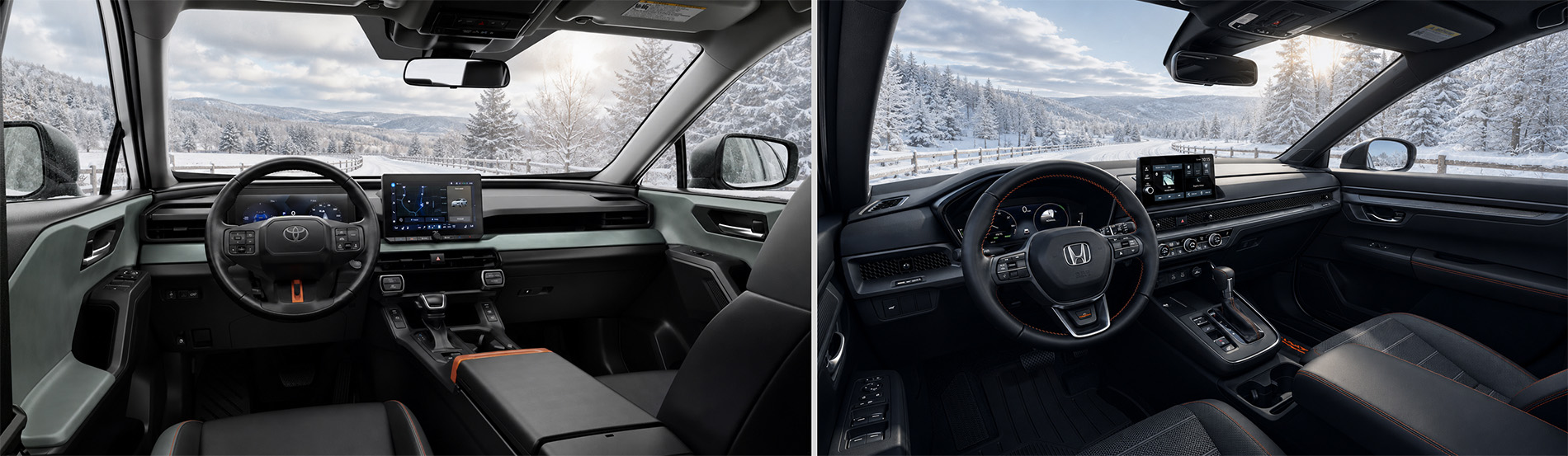
Both trims cover the technology most owners use every day. Woodland provides the larger displays, while TrailSport Hybrid counters with more audio output, a more adjustable driver’s seat, and the same key heated, charging, parking, blind-spot, and smartphone functions. The better interface is best judged in person.
Comparison Topic 7 of 7
Standard Equipment, Value & Buyer Fit
Where the price goes and which standard features earn their keep
Equipment, Price & Ownership-Fit ComparisonEquipment, pricing, delivery charges, accessories, colors, incentives, and inventory can change. Confirm the window sticker on the exact vehicle.
Category
2026 Honda CR-V TrailSport Hybrid
2026 Toyota RAV4 Woodland
Starting Price Position
Starts $1,100 lower before destination and options.
Higher base MSRP, offset by more factory utility hardware.
AWD & All-Terrain Tires
Both standard.
Both standard.
Cold-Weather Equipment
Heated front seats, heated steering wheel, heated mirrors, Snow mode, and heated wiper zone.
Heated front seats, heated steering wheel, heated mirrors, Snow mode, and rain-sensing wipers with de-icer.
Standard Utility Equipment
Roof rails, all-weather mats, cargo-area 12V outlet, and programmable power tailgate.
Crossbars, tow hitch, cargo liner, 120V/1500W outlet, auxiliary fog lights, and power liftgate.
Passenger-Use Strength
More passenger volume, more rear legroom, and strong driver-seat adjustment.
Slightly more cargo behind the rear seat and a shorter exterior length.
Power & Efficiency Strength
204 hp and 35 combined MPG.
236 hp and 38 combined MPG.
Strongest Reason to Choose
Comfort, rear-seat usefulness, approachable controls, and a lower entry price in a daily-focused outdoor hybrid.
Towing, clearance, factory hitch and roof equipment, cargo power, and a more complete utility package.
Main Tradeoff
Less towing capacity and less factory trail equipment.
Higher price, less rear legroom, and less passenger volume.
Value & Buyer-Fit Takeaway
TrailSport Hybrid puts more of its value into the cabin and everyday ownership experience. Woodland asks more but includes equipment that would otherwise require accessories or a different tow-capable vehicle. Value depends on whether those Woodland items will be used or simply carried around.
1 of 7
Which Outdoor-Inspired Hybrid SUV Fits Your Routine?
The better choice comes from identifying which equipment and space advantages will affect a normal week rather than choosing by styling or one headline specification.
Comfort-First Daily Ownership
Choose CR-V TrailSport Hybrid
TrailSport Hybrid fits drivers whose outdoor trips have to coexist with commuting, errands, school schedules, and regular passenger use. It keeps the cabin, ride, and controls at the center of the experience while adding the AWD, tires, and cold-weather features needed for changing Hudson Valley conditions.
Towing & Factory Utility
Choose RAV4 Woodland
Woodland fits drivers whose plans routinely include a trailer, roof-mounted equipment, powered campsite gear, or rougher access roads. Its factory utility hardware reduces the need to recreate the package later with accessories.
Rear-Seat & Cabin Usability
CR-V Gives People More Room
Choose the CR-V when the second row stays busy. Adults, growing children, child seats, and longer family trips benefit from a cabin that gives passengers more usable room without sacrificing flexible cargo space.
Clearance & Woodland Identity
RAV4 Adds More Trail-Access Hardware
Choose Woodland when the vehicle’s exterior equipment is central to the purchase. The slightly higher clearance, more favorable approach geometry, ready-to-use roof system, hitch, and trail lighting give it the stronger factory identity for gear-heavy trips. Functionally, these differences will be apparent in very rough terrain, but more of an aesthetic choice for most situations.
Interactive Outdoor-Hybrid SUV Finder
Should You Choose the CR-V TrailSport Hybrid or RAV4 Woodland?
Answer seven questions to see whether the Honda, Toyota, or both SUVs deserve a closer look based on commuting, towing, clearance, passenger use, cargo, weather, technology, and outdoor equipment.
Quiz results are general shopping guidance only. Final fit depends on exact equipment, pricing, towing needs, passenger use, cargo, tire preferences, inventory, and your specific driving routine.
Compare the Everyday Experience
Test-Drive the 2026 CR-V TrailSport Hybrid at Middletown Honda
A test drive can clarify the differences that specifications cannot: seat comfort, rear-seat access, hybrid response, visibility, control layout, tire noise, and ride quality on the roads you travel most.
Final Thoughts: CR-V TrailSport Hybrid or RAV4 Woodland?
The RAV4 Woodland is the more purpose-built utility choice. Its stronger towing capability, additional clearance, and factory-installed gear make sense for drivers whose weekends regularly involve trailers, roof equipment, powered accessories, or rougher access roads.
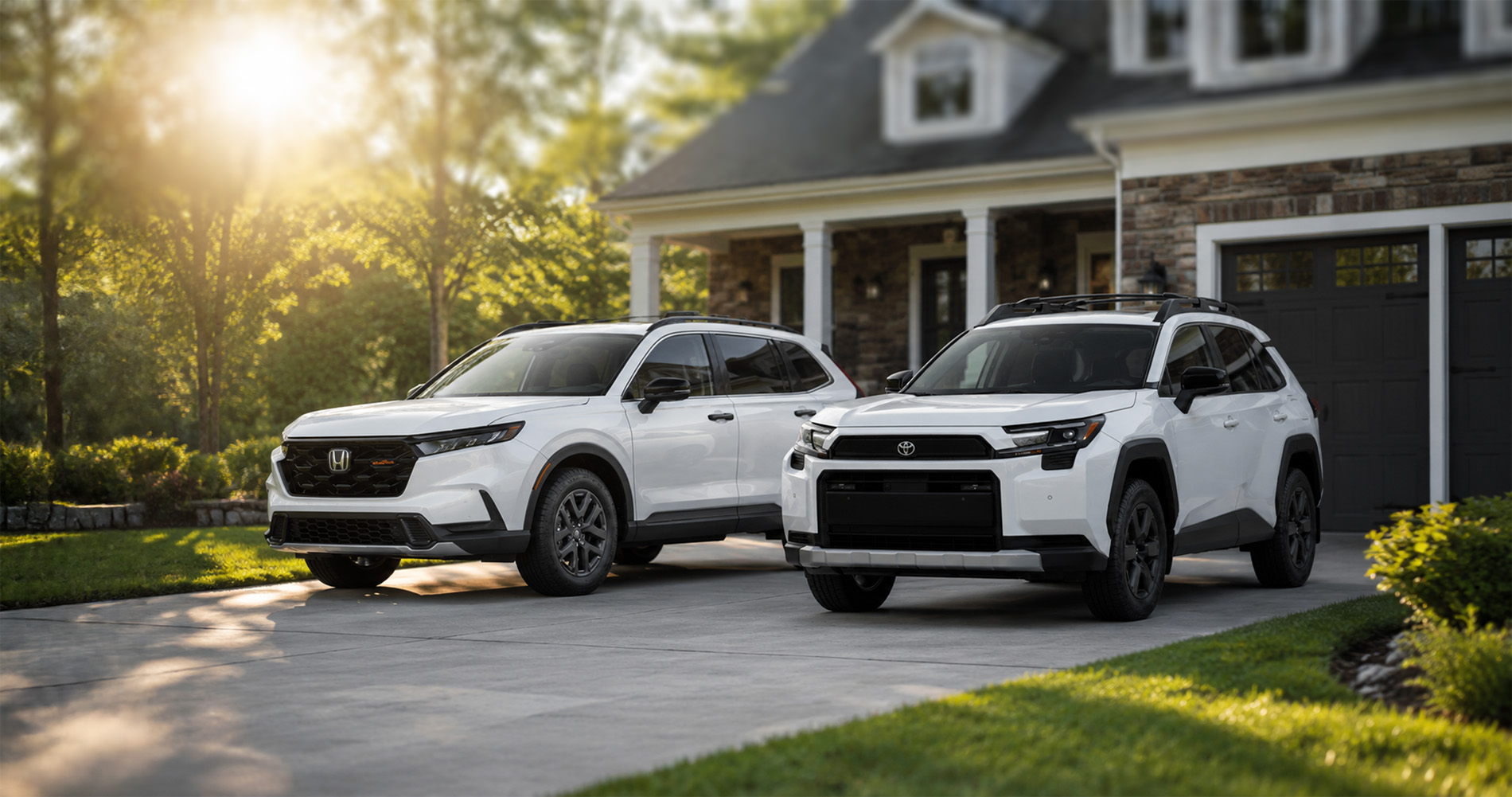
The CR-V TrailSport Hybrid is the more natural daily companion when passengers, commuting, cabin comfort, and easy controls shape most of the week. Both provide AWD, hybrid efficiency, all-terrain tires, and useful light-trail confidence. The deciding question is whether your outdoor priorities require Woodland’s additional hardware or fit more naturally around the Honda’s everyday strengths.
FAQ: 2026 RAV4 Woodland vs CR-V TrailSport Hybrid
Are the CR-V TrailSport Hybrid and RAV4 Woodland true off-road SUVs?▼
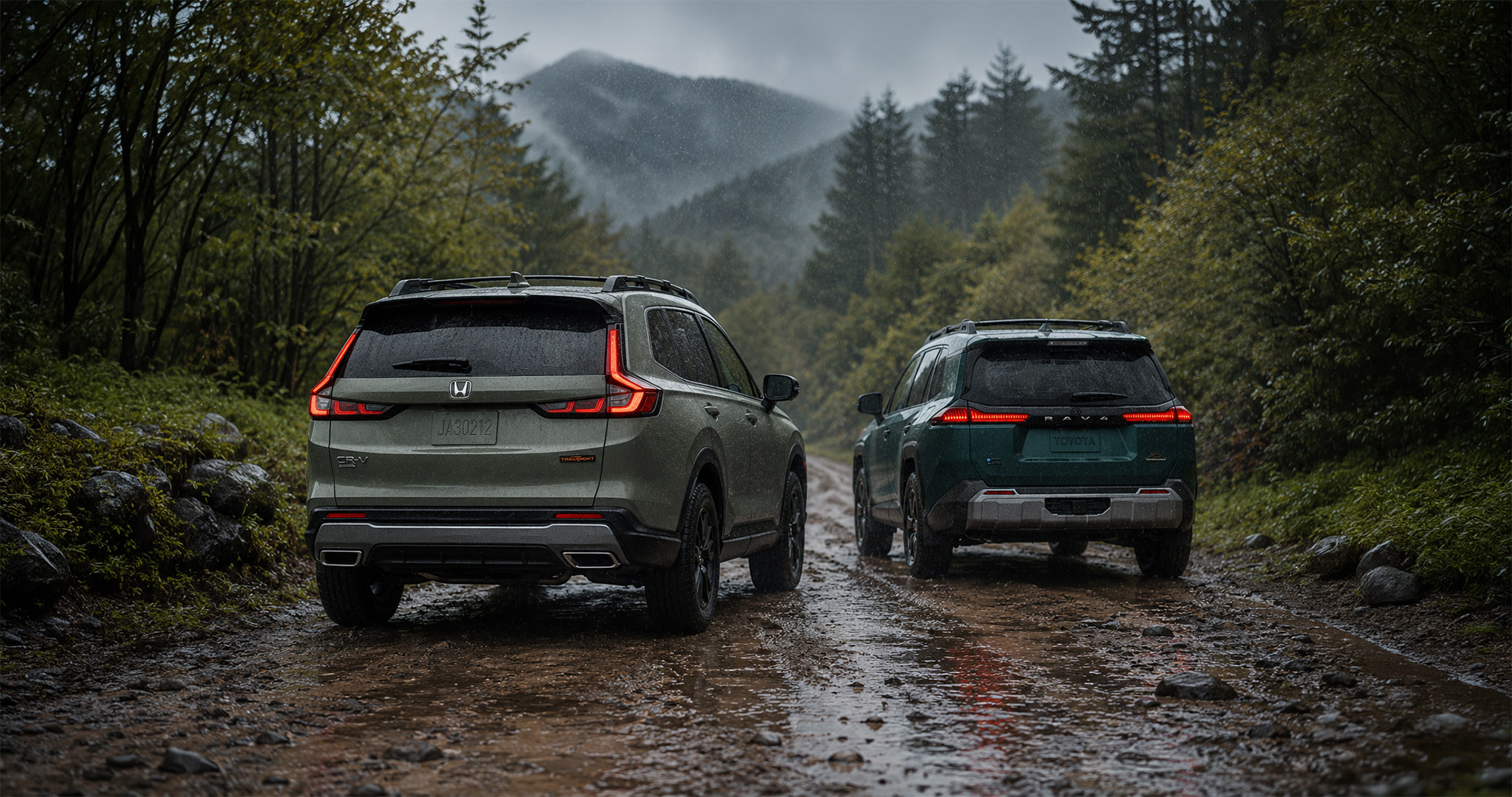
No. Both add AWD, all-terrain tires, useful clearance, and traction-support features for snow, gravel, campgrounds, and maintained access roads. Neither provides low-range gearing, locking differentials, or the hardware expected from a dedicated rock-crawling SUV. Woodland has the stronger factory setup for light off-pavement access, while TrailSport Hybrid keeps more emphasis on normal road comfort.
Which has more ground clearance, CR-V TrailSport Hybrid or RAV4 Woodland?▼
RAV4 Woodland lists 8.5 inches of ground clearance, while CR-V TrailSport Hybrid lists 8.2 inches. Woodland also lists 20-degree approach and 24-degree departure angles, compared with 16.1 and 21.3 degrees for the Honda.
Which can tow more, CR-V TrailSport Hybrid or RAV4 Woodland?▼
RAV4 Woodland can tow more. Toyota lists a 3,500-lb maximum towing capacity for Woodland. Honda lists up to 1,000 lbs for CR-V hybrid models when properly equipped with the required towing accessories.
How do their AWD systems differ?▼
CR-V TrailSport Hybrid uses Honda Real Time AWD with a propeller shaft and rear differential to transfer power rearward when needed. RAV4 Woodland uses Electronic On-Demand AWD with a dedicated rear electric motor rather than a mechanical connection between the front and rear axles.
Which is better for winter driving?▼
Both include standard AWD, all-terrain tires, Snow mode, heated front seats, and a heated steering wheel. CR-V TrailSport Hybrid is the stronger comfort-first winter commuter, while Woodland adds slightly more clearance, rain-sensing wipers with de-icer, Trail mode, and Downhill Assist Control. Proper winter tires can matter more than the small clearance difference in severe conditions.
Which is better for camping or outdoor gear?▼
Woodland is better when camping involves a trailer, roof-mounted equipment, powered gear, or rougher access roads because it includes a factory hitch, crossbars, a 120V/1500W cargo outlet, additional clearance, and auxiliary fog lights. TrailSport Hybrid works well when camping gear stays mostly inside the cabin and daily comfort matters more.
What should I compare during a test drive?▼
Compare front-seat comfort, rear-seat access, visibility, control layout, hybrid response, tire noise, ride quality, parking ease, and cargo loading. Those differences can matter more in daily ownership than a small advantage on a specification sheet.
What areas does Middletown Honda serve?▼
Middletown Honda serves drivers from Middletown, Goshen, Monroe, Warwick, Newburgh, Port Jervis, Monticello, nearby Orange County communities, and the broader Hudson Valley.
CR-V Hybrid Shopping Support at Middletown Honda
At Middletown Honda, we can help you compare available CR-V Hybrid configurations, review TrailSport-specific equipment, and determine whether the trim fits your passenger, commuting, cargo, and weekend-use priorities. An in-person comparison also gives you time to evaluate seating, visibility, controls, ride quality, and cargo access before choosing a vehicle.
Our online tools support the rest of the shopping process with current inventory, Honda offers, trade valuation, financing applications, and test-drive scheduling. Our team can also explain how accessories, pricing, leasing, and availability affect the exact CR-V Hybrid you are considering.
Middletown Honda also provides service, parts, tire, and maintenance support after the purchase, giving Orange County and Hudson Valley drivers one place to manage both the initial comparison and long-term Honda ownership.
Where To Go Next
Continue researching the 2026 CR-V Hybrid, then compare live inventory, current offers, financing, trade value, and test-drive options through Middletown Honda.
Disclaimers:
*MSRP figures are manufacturer suggested retail prices and exclude taxes, title, license, registration, dealer-installed accessories, optional equipment, and other fees unless stated. Honda destination and Toyota delivery, processing and handling charges are separate, can change, and may vary by region. Dealer pricing, incentives, and availability change regularly.
*Honda fuel-economy figures are EPA estimates. Toyota Woodland figures are manufacturer estimates in the supplied product information. Actual mileage will vary based on driving, weather, traffic, loading, tires, maintenance, and other conditions.
*Horsepower figures use each manufacturer’s published methodology. Electric-motor torque figures are not the same as combined hybrid-system torque, and Toyota does not publish one combined system-torque figure for Woodland.
*Maximum towing requires the correct vehicle, hitch, accessories, trailer equipment, loading, tongue weight, operating conditions, and owner’s manual guidance. Passengers and cargo reduce available capacity. Never exceed any vehicle, axle, hitch, trailer, or tire rating.
*Cargo, passenger, dimensional, ground-clearance, and approach/departure measurements can use different manufacturer methods and can vary with equipment, seat position, accessories, tires, and loading.
*All-terrain tires, AWD, drive modes, hill-descent systems, clearance, and traction features do not make either vehicle suitable for every trail or condition. They do not replace attentive driving, appropriate tires, safe speeds, obstacle assessment, or recovery planning.
*Trim content, technology, connected services, trials, subscriptions, accessories, colors, packages, and inventory are subject to change. Verify the window sticker and current manufacturer and dealership information for the exact vehicle.
*Honda Sensing, Toyota Safety Sense, parking systems, blind-spot systems, braking support, and other driver-assistance features have operational limits and are not substitutes for safe, attentive driving.
*Car and Driver ratings, awards, rankings, and editorial conclusions are third-party opinions and were verified July 20, 2026. Rankings and accolades can change.